How to Get More GitHub Stars: Data From 75 AI Repos
How AI repos really gain GitHub stars, from 50 days of tracking the fastest risers: how many stars a day it takes to stand out, how fast stars snowball once a repo takes off, and the honest ways to get there.
What the numbers say
- 1,148 stars in a day: median for the day's #1 rising AI repo
- 316 for #3
- 51 for #8
- 1,438 median stars when a repo first made the list
Only 2 of the 75 repos that made Upcurrent's daily AI list had fewer than 1,000 stars on their first day there. Repos rarely appear from nothing: by the time they trend, they already have a launch behind them. Most don't stay long either: the median repo stayed on the list for 3 days, and 14 lasted a single day.
From Upcurrent's daily lists of the fastest-rising AI repos on GitHub, 2 October 2026 to 23 November 2026 (50 days). Some daily gains are estimates where GitHub's data was late.
Stars snowball once a repo takes off
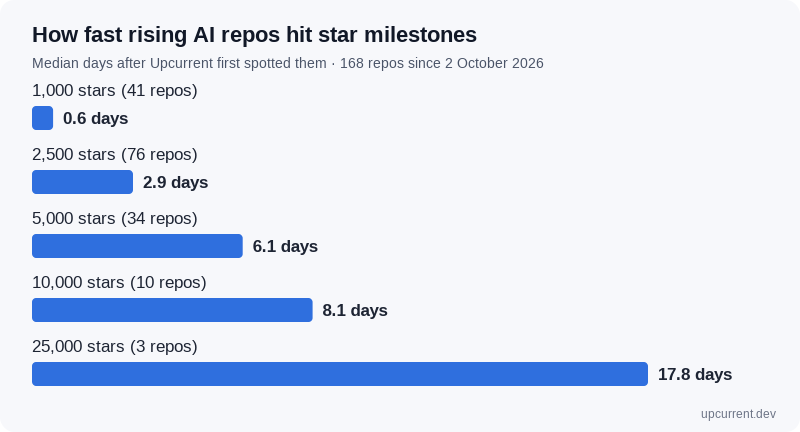
Of the 168 rising AI repos Upcurrent has tracked, 41 passed 1,000 stars (median 0.6 days after first being spotted), 76 passed 2,500 stars (median 2.9 days after first being spotted), 34 passed 5,000 stars (median 6.1 days after first being spotted), 10 passed 10,000 stars (median 8.1 days after first being spotted), 3 passed 25,000 stars (median 17.8 days after first being spotted). The first push is the hard part; after that, trending pages, newsletters and social shares do the work.
Ten honest ways to get more stars
- Solve one clear problem, and say it in the first lineThe description is what people see in lists like this one. The repos that topped Upcurrent's list say what they do in one plain sentence.
- Show it working before anything elseA GIF, screenshot or 30-second video at the top of the README beats paragraphs of features.
- Make it run in one commandEvery extra setup step loses people who would have starred it.
- Launch where developers already lookA Show HN post, relevant subreddits and launch platforms, all on the same day, so the stars arrive close together.
- Concentrate your launch into one dayTrending lists reward stars gained in a short window, not your total.
- Add GitHub topicsTopics like ai-agents or mcp-server put you on GitHub's topic pages and in filtered lists such as Upcurrent's MCP servers list.
- Ride a current waveBuild for what people are excited about this month. See what's trending now and new AI projects explained.
- Ask for the star, onceA single line in the README ("If this helped, a star helps others find it") is fine. Spamming people is not.
- Reply to every issue fast in launch weekEarly users who get help become the ones who share it.
- Never buy starsIt breaks GitHub's rules and researchers have shown it stops helping within two months. Why buying GitHub stars backfires.
The biggest single days on the list
- deepseek-ai/dsh-superagent-prototype4,369 stars in a day · best rank #1 · 7 days on the list
- wheresryan22/anatomy4,311 stars in a day · best rank #1 · 4 days on the list
- feder-cr/git-ai2,623 stars in a day · best rank #1 · 4 days on the list
- Gathin23/tv-vibehack2,222 stars in a day · best rank #2 · 1 day on the list
- simbasjungles/free-my-tv1,956 stars in a day · best rank #1 · 3 days on the list
- ccch1mneyyy/dsh-Go1,913 stars in a day · best rank #1 · 2 days on the list
- omlahore/RemoveMacAI1,891 stars in a day · best rank #1 · 1 day on the list
- worldonlyu/Google_AI_Pro_2Year_ZeroCost_Auto1,621 stars in a day · best rank #1 · 4 days on the list
What GitHub stars mean
GitHub's own docs describe a star as a bookmark: starring makes it easy to find a repository again and shows appreciation to the maintainer. GitHub also says many of its repository rankings depend on star counts, and Explore shows popular repositories by stars. That's why stars matter for being found, even though they say little about code quality. (GitHub Docs, "Saving repositories with stars", checked 22 November 2026.)
Launched something? Get it seen
Every new AI repo with 100+ stars is tracked by Upcurrent for free, and the fastest risers make the trending list on their own. Want a guaranteed, clearly labelled spot while you wait? See promote your AI project.
Questions
How do I get more GitHub stars?
Make the repo's purpose clear in one line, show a demo at the top of the README, make it run in one command, and launch it everywhere on the same day so stars arrive together.
How many stars do you need to trend on GitHub?
On Upcurrent's daily list of rising AI repos, the #1 repo gained a median of 1,148 stars in a day and the #8 repo 51. GitHub's own Trending page doesn't publish its formula.
What do stars on GitHub mean?
A star is a bookmark and a thank-you. GitHub uses star counts in many of its rankings, so stars help people discover a repo.
How long does it take to get 1,000 GitHub stars?
For AI repos that took off, it was quick: the 41 tracked repos that passed 1,000 stars did it a median 0.6 days after Upcurrent first spotted them. Most repos never get there.
Can I buy GitHub stars?
Sellers exist, but fake stars break GitHub's Acceptable Use Policies, which ban automated starring and secondary markets for inauthentic activity. Accounts and repos can be removed.
Get this in your inbox at 7am
One free email each morning with the AI repos, models and stories that are picking up speed, including new free models. Your own time zone, no spam.